
The financial landscape in the NBA continues to change on a yearly basis, as franchise values go up, revenue comes into the league and the Collective Bargaining Agreement (CBA) changes how that money can be accessed. The growth of the NBA means that star players get an increasingly larger pie from which they can get paid.
That means the salaries for the top-tier players will continue to reach eye-popping levels. Jaylen Brown signed the largest contract in the history of the league not because he is better than every player in history (or even right now) but because he hit free agency at the right time.
Scottie Barnes will be due for an extension
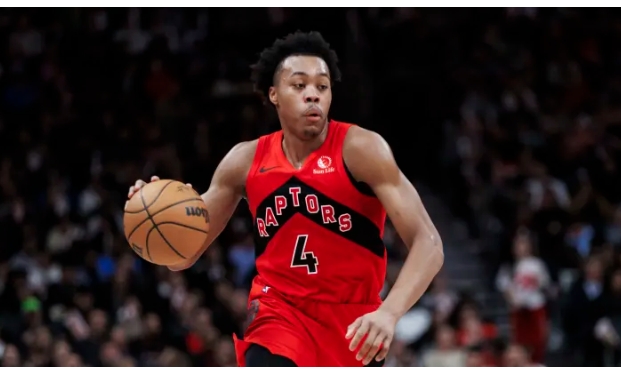
The Toronto Raptors will be dealing with that new financial landscape as early as this summer, as All-Star forward Scottie Barnes will be eligible to negotiate and sign an extension on his rookie contract. Just a decade ago, the contract DeMar DeRozan signed was a three-year, $28.5 million deal, then further into his prime he inked a five-year, $139 million deal.
Oh how times have changed.
The last time the Raptors negotiated such a deal with a player who had made the leap was Pascal Siakam, who signed a four-year, $136 million extension in October 2019. Siakam hadn’t yet made an All-Star team (he would in his fourth season) but he had started and played a key role on the Raptors’ 2019 championship team.
The financial landscape will be completely different even five years later for Barnes. He joins players such as Cade Cunningham and Franz Wagner as those who have already made a star turn and will be commanding salaries near the top of the available range. How high could those salaries get?
Part of figuring that out will depend on exactly how much the salary cap rises. Agreeing to a contract this upcoming offseason will mean their deal begins in the 2025-26 season, so the increases to the cap not only this upcoming summer but the following one will set the starting point.
How much can Scottie Barnes make?
Cap expert Eric Pincus looked into the 2021 NBA Draft class to predict the contracts each player would be signing. He helpfully built some categories out for rookie contract extensions, with “supermax potential” being his most expensive group, followed by “near-max”, large, mid-tier and small.
Where would Scottie Barnes land? Pincus rightfully predicts that he would fall into the maximum contract group, which means he could sign a deal up to 25 percent of the salary cap. With the salary cap in 2025-26 tentatively projected at around $155 million, Barnes would be making $38.75 million in the first year of his new deal.
There is more to the story, however. Pincus points out that Barnes has been good enough to negotiate a designated rookie extension, which is more than simply a max deal. It also includes language commonly referred to as the “Rose Rule” as Derrick Rose was the impetus for building this allowance into the CBA.
In short, if a player signs a designated rookie extension their contract value is not simply the standard 25 percent max, they can bump that number as high as 30 percent if they achieve certain accomplishments in their fourth season: win MVP, Defensive Player of the Year or land on an All-NBA Team.
Only the best couple of players in each draft class can negotiate this into their contract, but Pincus thinks Barnes falls into that group. Anyone watching Barnes carry this Raptors team at time this season would likely agree. His offensive game has advanced alongside his defensive ability to put him on the trajectory to perennial stardom.
