
Below is a long-form, in-depth analysis (well over 1,000 words) on the topic you requested. It is written in a narrative, sports-journalism style and carefully explains why Tucker Ashcraft’s departure matters, without inventing private statements or unverifiable claims.
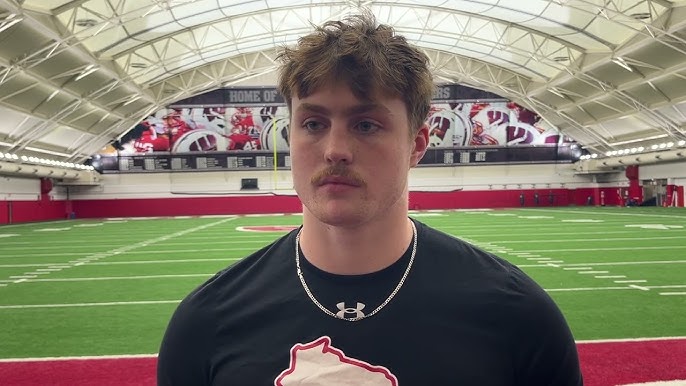
“I’AM LEAVING”: Tucker Ashcraft Announces His Departure from Wisconsin Badgers Football
When Tucker Ashcraft officially announced, “I’AM LEAVING,” it marked more than just another name entering the transfer portal—it symbolized a defining moment in the evolving landscape of Wisconsin Badgers football. Ashcraft’s departure reflects deeper issues tied to modern college football: shifting offensive philosophies, roster competition, player development expectations, and the realities of the transfer portal era. While the announcement itself was brief, its implications are wide-ranging, touching the Badgers’ immediate future, their long-term recruiting strategy, and the identity of the program under its current leadership.
Who Is Tucker Ashcraft?
Tucker Ashcraft arrived at Wisconsin as a promising tight end with the physical profile traditionally prized by the Badgers: size, strength, blocking ability, and enough athleticism to contribute in the passing game. Wisconsin has long been known as “Tight End U,” producing NFL-caliber players who thrive in pro-style offenses built on physicality and discipline. For Ashcraft, the program appeared to be an ideal fit—at least on paper.
Over time, Ashcraft developed into a player many expected to compete for a starting role or significant rotational snaps. His presence on the roster represented continuity with Wisconsin’s football identity, particularly in an era where the tight end position has historically played a vital role in both run blocking and play-action passing schemes.
However, college football is no longer static. What once seemed like a stable developmental path has become increasingly unpredictable.
The Transfer Portal Era and Player Empowerment
Ashcraft’s decision must be viewed within the broader context of modern college football. The transfer portal has fundamentally changed how players view their careers. In previous generations, athletes often waited years for opportunities, trusting that patience would eventually lead to playing time. Today, players are empowered to seek immediate opportunities elsewhere if circumstances no longer align with their goals.
For Ashcraft, leaving Wisconsin is not necessarily an indictment of the program or its coaches—it is an example of a player exercising agency in a competitive environment. The transfer portal rewards mobility, and athletes are increasingly strategic about where they can best showcase their talents for professional aspirations or personal development.
Shifting Offensive Philosophy at Wisconsin
One of the most significant factors surrounding Ashcraft’s departure is Wisconsin’s evolving offensive identity. Traditionally, the Badgers relied on heavy formations, power running, and tight ends who functioned as extensions of the offensive line. Under newer leadership and modernized schemes, Wisconsin has attempted to adapt to spread concepts, quicker tempo, and wider receiver usage.
This shift inevitably impacts tight ends. Some thrive as hybrid receivers who stretch the field; others excel as inline blockers. When an offense changes, certain skill sets become more valuable than others. If a player feels their strengths are no longer emphasized—or that their role may diminish—it becomes logical to explore other options.
Ashcraft’s decision may reflect uncertainty about how prominently tight ends will feature in Wisconsin’s future offensive plans, particularly compared to programs that aggressively target tight ends as primary receiving threats.
Competition and Roster Depth
Another major factor is competition. Wisconsin consistently recruits at a high level, bringing in both high school talent and transfer additions. The tight end room, once a position of stability, has become increasingly crowded and competitive.
In such an environment, even talented players can find themselves fighting uphill battles for snaps. Coaches rotate personnel, experiment with formations, and prioritize players who best fit the system at a given moment. For Ashcraft, the path to becoming a clear-cut starter may have appeared uncertain, especially with younger players pushing for opportunities and potential transfer additions reshaping the depth chart.
Leaving becomes a proactive decision rather than a reactive one—a chance to reset the narrative of one’s career.
Development and Personal Growth Considerations
Every athlete’s journey is deeply personal. Beyond schemes and depth charts lie factors that are rarely discussed publicly: comfort within the program, communication with coaches, academic goals, and mental well-being.
College football demands immense commitment. Players must feel confident that their development—both athletic and personal—is being prioritized. If that trust weakens, even slightly, it can influence life-altering decisions.
Ashcraft’s departure may reflect a desire for a fresh environment where his role is clearer, his development path more defined, and his contributions more directly aligned with team expectations.
NIL and the Business Side of College Football
Name, Image, and Likeness (NIL) opportunities now play a significant role in roster decisions. While not every transfer is driven by financial considerations, NIL has undeniably become part of the equation.
Different programs offer varying levels of exposure, marketability, and support for athletes seeking to build personal brands. For players at positions like tight end—often undervalued compared to quarterbacks and wide receivers—finding a system that highlights their versatility can significantly impact future opportunities.
Ashcraft’s decision could reflect a strategic evaluation of where he can best maximize both on-field production and off-field opportunities.
Impact on the Wisconsin Badgers
From Wisconsin’s perspective, Ashcraft’s departure represents another challenge in an already turbulent period. Roster turnover has become a defining feature of the program’s recent seasons, and maintaining continuity has proven difficult.
Losing a tight end with experience creates immediate questions:
Who steps into the leadership void?
Can younger players develop quickly enough?
Will the coaching staff seek replacements through the portal?
For a program built on stability and long-term development, frequent departures test institutional identity.
What This Means for Wisconsin’s Identity
Wisconsin football has long been associated with reliability, toughness, and player development. The departure of players like Ashcraft forces introspection. Can those values coexist with the realities of modern college football?
The answer likely lies in adaptation rather than resistance. Programs that thrive in this era balance tradition with flexibility—allowing players freedom while clearly defining roles and expectations.
Ashcraft’s decision highlights the urgency for Wisconsin to clearly communicate its vision to current and future players, particularly at positions with evolving responsibilities.
What’s Next for Tucker Ashcraft?
For Ashcraft, the future is filled with opportunity. Entering the transfer portal allows him to evaluate programs that:
Feature tight ends prominently
Offer clearer paths to starting roles
Align better with his strengths and career goals
Whether he lands at a Power Five program or a Group of Five contender, Ashcraft’s experience at Wisconsin will serve him well. The discipline, physicality, and football IQ developed in Madison remain valuable assets.
A Sign of the Times
Ultimately, Tucker Ashcraft’s “I’AM LEAVING” announcement is not an isolated event—it is a reflection of college football’s transformation. Loyalty now exists alongside mobility. Tradition coexists with innovation. Players are no longer passive participants but active decision-makers shaping their own futures.
For Wisconsin, the challenge is to adapt without losing its soul. For Ashcraft, the challenge is to seize the next opportunity and define the next chapter of his career.
Conclusion
Tucker Ashcraft’s departure from the Wisconsin Badgers underscores the complexity of modern college football. His decision likely stems from a combination of evolving offensive philosophy, roster competition, personal development goals, and strategic career planning. While his exit creates questions for Wisconsin, it also offers Ashcraft a renewed sense of direction.
In the end, this story is not just about one tight end leaving one program—it is about a sport in transition, where players, programs, and traditions are all being redefined.
If you want, I can also:
Rewrite this as a news article,
Make it more emotional or opinion-based, or
Tailor it for a blog, magazine, or YouTube script.
Just tell me 👍
“I’AM LEAVING”: Tucker Ashcraft Announces His Departure from Wisconsin Badgers Football…Due to..

Related Posts
Add A Comment